This site contains affiliate links. I may earn a small commission, at no extra cost to you. Please view the disclosure for more information
Daily clutter in a small apartment doesn’t usually come from one big problem. It builds slowly, almost unnoticed.
A jacket gets left on a chair because it’s easier than putting it away. Keys end up in a different spot every day. Mail collects in small stacks that never fully get cleared. None of these feel significant in the moment, but together they change how the entire space functions.
In a small apartment, clutter isn’t just visual. It’s functional.
When everyday items don’t have a defined place, they interrupt how you move through your space. They slow you down, create friction in routines, and make even a clean apartment feel disorganized.
That’s why most storage advice falls short.
It focuses on adding more storage instead of fixing the systems that allow clutter to build in the first place.
The goal isn’t to fit more into your apartment. It’s to create a space where clutter doesn’t form as part of your daily routine.
If you’ve already started structuring your home with “Where to Put Everything in a Small Apartment (Room-by-Room Guide)”, this is the next layer. Instead of assigning space, you’re creating systems that maintain it.
If you’re starting to fix daily clutter as you read, a few small changes make the biggest difference. These are the types of pieces that help create structure without taking up extra space.
This site contains affiliate links. I may earn a small commission, at no extra cost to you. Please view the disclosure for more information
Why Daily Clutter Builds Faster in Small Apartments

In larger homes, clutter has somewhere to go. It can be moved into another room, pushed into a corner, or temporarily hidden without immediately affecting how the rest of the space feels. That separation creates a buffer between daily habits and visual impact.
In a small apartment, that buffer disappears. Everything exists in the same environment. The living room blends into the kitchen, the bedroom may double as an office and entryways are often nonexistent or minimal. Because of this, even a small amount of clutter becomes part of the entire space instead of staying contained to one area.
This is what makes clutter feel heavier in small apartments. It’s not necessarily that there is more of it, it’s that it’s more visible, more concentrated, and more disruptive to how the space functions. A few misplaced items don’t just look messy; they change how you move through your apartment.
Clutter also builds faster because of repetition. Most clutter doesn’t come from one big moment. It comes from small, repeated decisions throughout the day. Something gets set down quickly, a task gets delayed, and an item doesn’t have a clear place, so it’s left where it’s convenient.
These decisions feel temporary, but they repeat often enough that they become habits. Once that happens, clutter stops being accidental and starts becoming part of the system. A surface that holds items once becomes a surface that always holds items. A chair becomes a place for clothes. A corner becomes overflow storage. Over time, these patterns define the space more than your original layout ever did.
This is why cleaning alone doesn’t solve the problem. You can reset the space, but if the patterns remain the same, the clutter will return just as quickly. The issue isn’t the presence of clutter, it’s the conditions that allow it to form.
Fixing daily clutter means changing those conditions. When items have a clear place to go, they stop floating between surfaces. When storage is easy to access, it gets used. And when systems match your actual habits instead of ideal ones, they hold up over time.
That’s when clutter stops building in the first place.
Creating Storage That Matches Real Life
The biggest mistake in small apartment organization is designing storage based on how things should work instead of how they actually do.
Most systems look good when they’re first set up. Everything has a place, categories are clearly defined, and the space feels organized. But over time, those systems start to break down, not because they were poorly designed, but because they weren’t realistic.
Real life isn’t perfectly structured. You don’t always have time to fold things neatly, or put items back immediately, and you don’t always follow the same routine every day. When storage systems don’t account for that, they become difficult to maintain and that is where friction starts.
If putting something away takes more effort than leaving it out, it will be left out. If storage is too far from where something is used, it won’t be used consistently. And if a system requires too many steps, it eventually gets ignored.
Effective storage removes that friction. It places items where they naturally land. It simplifies the process of putting things away. And it allows for small inconsistencies without breaking down completely.
This is why placement matters more than capacity. Instead of asking where something should go, it’s more effective to ask where it naturally ends up. That location becomes the starting point for your storage system.
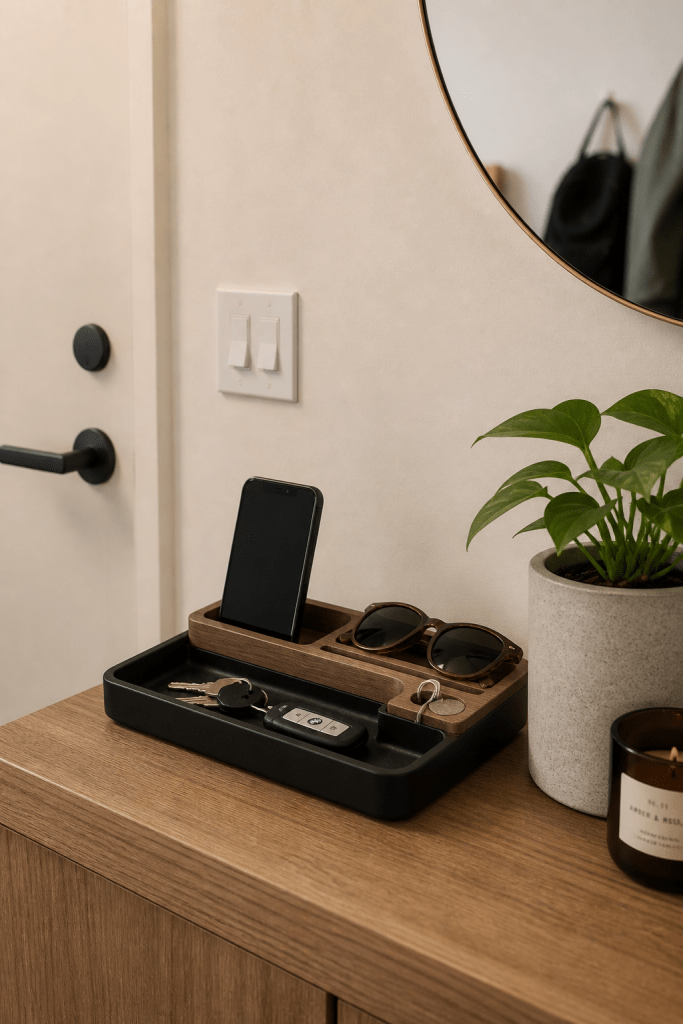
A compact solution like the Umbra Bellwood Organizer creates a structured drop zone without adding visual clutter. Instead of items spreading across multiple surfaces, everything has a defined place to land the moment you walk in, which removes the need to constantly reset your space.

This small shift reduces decision-making. Instead of figuring out where something goes every time, you already know. Over time, that consistency becomes automatic, and the system maintains itself without effort.
Using Vertical Space Without Overcrowding

Vertical space is often treated as the solution to small apartment storage, but it’s not always used effectively. Adding storage upward can either make a space feel larger and more functional, or more crowded and visually heavy. The difference comes down to how that space is used.
When vertical storage is too dense or bulky, it compresses the room. It creates visual weight that pulls everything inward, making the space feel tighter than it actually is. On the other hand, when vertical storage is open and layered, it creates depth.
This is what makes certain pieces more effective than others. A piece like the VASAGLE Ladder Bookcase allows you to use vertical height while still keeping the room visually open.

That movement is important. In small apartments, visual flow has a direct impact on how spacious a room feels. When storage interrupts that flow, the room feels smaller but when it supports it, the room feels more open.
This is why spacing matters just as much as storage itself. Leaving small gaps between items, using lighter materials, and avoiding overly dense arrangements all contribute to a more balanced space. The goal isn’t to fill every inch, it’s to use space intentionally without overwhelming it.
When vertical storage is approached this way, it doesn’t just add capacity. It changes how the entire room feels.
Hidden Storage That Doesn’t Feel Hidden

Hidden storage is often recommended for small apartments, but it only works when it remains accessible.
If something is too difficult to reach, it stops being part of your daily system. It becomes long-term storage, which doesn’t help with everyday clutter.
The key is integration.
Storage should be built into items you already use, not added as something separate. This allows it to exist naturally within the space instead of feeling like an extra layer.

A piece like the Christopher Knight Home Storage Ottoman creates storage without adding a new category of furniture. It serves a purpose visually while also holding items that would otherwise be left out.
This reduces visual clutter without removing accessibility. You don’t have to think about using it. You’re already interacting with it as part of your routine. That’s what makes it effective.
Hidden storage should feel effortless. It should allow you to put things away quickly, retrieve them easily, and maintain the system without needing to reorganize constantly. When it does that, it becomes part of your everyday environment instead of something you have to manage separately.
Fixing the “Drop Zones” That Create Clutter

Clutter tends to collect in predictable places. These areas aren’t random, they’re based on movement patterns. Wherever you naturally pause, set things down, or transition between activities becomes a drop zone.
Trying to eliminate these areas completely doesn’t work. They exist because they’re convenient. Instead of removing them, the goal is to structure them. When a drop zone has no definition, items spread outward, but when it has a clear boundary, clutter stays contained.
A wall-mounted solution like the Spectrum Diversified Wall Mount Rack creates an immediate place for items like bags, jackets, or accessories without taking up floor space.

This is especially important in small spaces where one cluttered area can affect everything else.
Once drop zones are controlled, clutter becomes predictable instead of overwhelming. It stays within a defined space and is easier to manage as part of your routine.
Once drop zones are controlled, clutter stops expanding outward.
Reducing Surface Clutter Without Losing Function
Surfaces are one of the most important elements in a small apartment. They’re where you prepare food, work, organize, and interact with daily items. Because of this, they naturally collect clutter. The goal isn’t to keep surfaces empty, it’s to keep them functional.
When items are scattered, surfaces lose their purpose. They become storage instead of workspace. This makes everyday tasks more difficult and adds to the feeling of disorganization.
Creating contained zones allows surfaces to stay usable while still holding necessary items.

This prevents small items from spreading and makes it easier to maintain a clean appearance without constantly clearing everything away.
It’s a balance between accessibility and containment.
Storage That Prevents Clutter Instead of Reacting to It
Most storage solutions are reactive. They’re added after clutter appears, which means they’re always one step behind the problem. While they can help contain clutter, they don’t stop it from forming.
Preventative storage works differently. It’s placed where clutter would naturally appear, and it intercepts items before they spread, which keeps the space organized without requiring constant effort.
This approach changes how you think about storage. Instead of asking how to store what you already have, you start asking how to prevent items from becoming clutter in the first place. That shift is what makes systems sustainable.
Maintaining a Clutter-Free System Over Time
Maintenance is what determines whether a system lasts. In small apartments, maintenance needs to be simple. If it requires too much time or effort, it won’t be consistent.
The goal is to reduce the need for maintenance, not increase it. When storage is working correctly, upkeep becomes quick adjustments instead of full resets. Items go back easily. Surfaces stay contained. Clutter doesn’t have time to build.
This is what allows a space to stay organized over time.
This aligns with “Small Apartment Cleaning Routine That Keeps Your Space Clutter-Free in 15 Minutes a Day”, where the focus is on consistency instead of intensity.
The goal isn’t perfection, it’s stability.
Shop This Post: Storage Solutions That Actually Fix Daily Clutter
This site contains affiliate links. I may earn a small commission, at no extra cost to you. Please view the disclosure for more information
If your goal is to fix daily clutter, the focus should be on pieces that support how your space is used every day.
| Product Image | Product Name / Price | Primary Button |
|---|---|---|
|
Vertical Storage
|
||
|
Kitchen Storage
|
||
|
Vertical Storage
|
||
|
Hidden Storage
|
||
|
Drop Zone
|
||
|
Vertical Storage
|
||
|
Drop Zone
|


- A structured drop zone like the Umbra Bellwood Organizer keeps everyday essentials contained in one place, preventing small items from spreading across surfaces and turning into daily clutter.
- For vertical storage that doesn’t overwhelm the space, the VASAGLE Ladder Bookcase adds layers without adding weight.
- To reduce visible clutter while maintaining function, the Christopher Knight Home Storage Ottoman provides hidden storage that still feels accessible.
- For managing drop zones, the Spectrum Diversified Wall Mount Rack creates structure without using floor space.
- And for keeping surfaces organized without removing access, the YouCopia StoraLid Container Organizer keeps items contained and easy to find.
Each of these works because it supports daily behavior instead of trying to change it.
Conclusion
Small apartment storage isn’t about adding more. It’s about working smarter with what you already have. When storage is designed around real life, clutter stops forming as part of your routine.
By focusing on vertical space, hidden storage, structured drop zones, and systems that match your habits, you create a space that stays organized without constant effort.
To continue optimizing your apartment, connect this with:
- Where to Put Everything in a Small Apartment (Room-by-Room Guide)
- Small Living Room Ideas that Make Your Space Feel Larger
- No Entryway? Smart Drop Zone Ideas for Small Apartments
- Small Apartment Cleaning Routine That Keeps Your Space Clutter-Free in 15 Minutes a Day
When these systems work together, your apartment doesn’t just look organized—it becomes easier to live in every day.
Leave a Reply