This site contains affiliate links. I may earn a small commission, at no extra cost to you. Please view the disclosure for more information.
Living in a small apartment isn’t really about having less, it’s about needing your space to work better.
When everything has a place, even a small space can feel calm and manageable. But when it doesn’t, clutter builds up quickly, and everyday routines start to feel harder than they should be.
What makes the biggest difference isn’t adding more storage everywhere. It’s choosing a few things that quietly support how you actually live in your space.
The right items don’t stand out, they just make everything feel easier to maintain.
Where Organization Usually Breaks Down

In most small apartments, things don’t fall apart all at once. It happens gradually. At least, that’s how I noticed it happening. It’s never one big mess that suddenly appears. It’s small things that don’t seem important in the moment. Laundry ends up on a chair just for the day. Keys get set down wherever is closest. A few items land on the counter because there isn’t an obvious place for them to go.
None of it feels like a problem on its own, but over time, those small habits start to overlap.
One pile turns into two. One surface becomes slightly harder to use. And before you realize it, the space starts to feel heavier than it actually is. That’s the part that makes a small apartment feel difficult to manage. Not the size, but the way things slowly spread without a clear place to stop.
What made the biggest difference for me wasn’t trying to stay more organized. It was stopping that spread before it started. One of the simplest ways to do that is by containing the things that tend to move around the most.
Laundry is a good example of this. It’s something that builds up naturally, and if there isn’t a clear place for it, it ends up wherever there’s space in the moment. A chair, the floor, the corner of a room. And once it starts, it’s easy for it to keep going.
A compact laundry sorter changes that pattern. Instead of deciding where things go every time, there’s already a place waiting. That removes the small decision you would otherwise have to make, and over time, that’s what keeps things from piling up elsewhere.
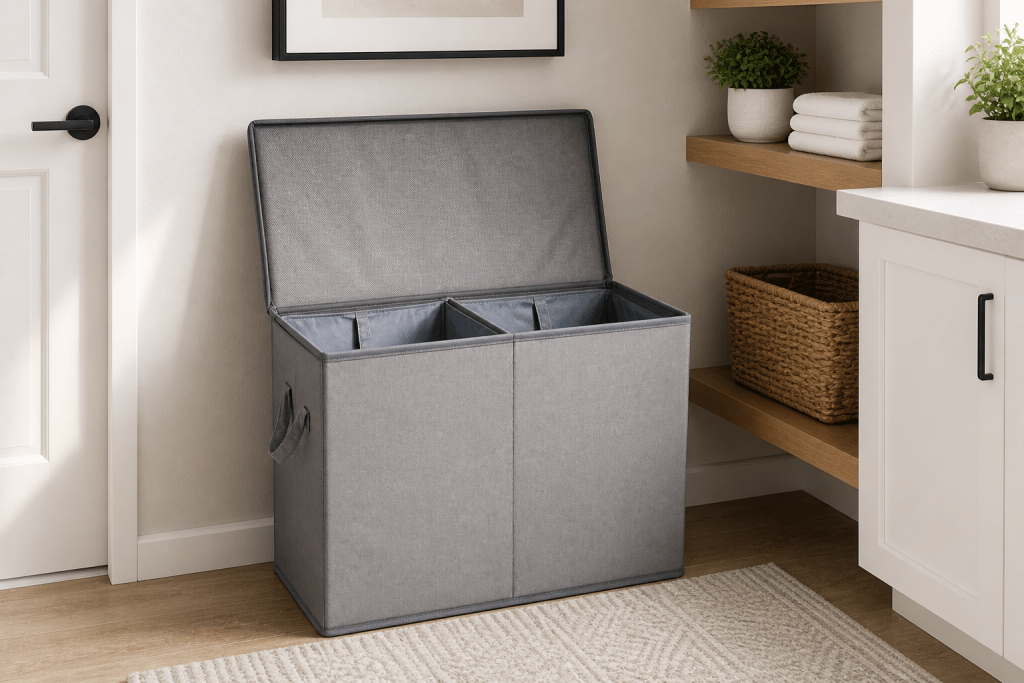
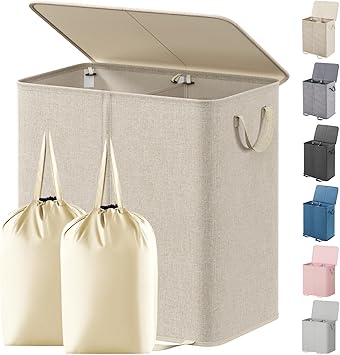
What I noticed almost immediately was that laundry stopped becoming something I had to “deal with later.” It had a place before it became a problem, which made the entire space feel more controlled without extra effort.
That same idea shows up in smaller, less obvious ways too. Things like keys, mail, and everyday items don’t seem like they take up much space, but they’re usually the first to spread. And because they’re used so often, they tend to get set down quickly without much thought.
Without a defined place, they slowly move across surfaces. At first, it’s just one or two items. But over time, it starts to build in a way that makes the space feel more cluttered than it actually is.
Creating a small drop zone fixes that without requiring a full entryway setup.
A simple tray gives those items a consistent place to land. It doesn’t need to be complicated or perfectly styled. It just needs to exist so that you don’t have to think about where things go every time you walk in.

The OAKOA Concrete Decorative Tray for Entryway Table works well for creating a simple drop zone.

Once I added something like this, I stopped seeing random items spread across different surfaces. Everything stayed where it was supposed to, not because I was trying harder, but because the setup made it easier.
That’s really what these changes come down to. They’re small, and they don’t feel dramatic in the moment. But they remove the conditions that allow clutter to build in the first place.
And over time, that’s what keeps a small apartment feeling manageable instead of overwhelming.
Why Clear Surfaces Change Everything

In a smaller space, surfaces do more than just hold things, they shape how the entire room feels. When counters, desks, or bedside areas are crowded, the space starts to feel smaller than it actually is. And once that happens, it becomes harder to keep things organized.
I didn’t notice this right away, but over time it became obvious that clutter doesn’t just take up space, it changes how you move through the room.
When a surface is full, you stop using it the way it was intended. A kitchen counter becomes something you work around instead of something you use. A desk becomes a place you avoid because there’s always something in the way. Even a small bedside area can start to feel cramped if there’s no clear place to set anything down.
And once surfaces feel unusable, everything else starts to follow.
What helps isn’t constantly clearing things away, it’s reducing how much ends up there to begin with.
That was the shift that made the biggest difference for me. Instead of cleaning surfaces over and over again, I started paying attention to why things were ending up there in the first place.
Usually, it came down to a lack of containment.
If something didn’t have a clear place to go, it ended up on a surface. And once one thing was there, it made it easier for more things to follow.
So instead of focusing on keeping surfaces clean, I focused on making it easier for things not to land there at all.
In the kitchen, this showed up immediately.
Dishes were always the main issue. Not because there were too many, but because there wasn’t a consistent place for them while they were drying. They would end up spread out across the counter, which made the entire space feel cluttered even if everything was technically clean.
A compact drying rack fixed that almost instantly. Instead of shifting things around to make space, everything had a contained area that didn’t interfere with how I used the rest of the counter. It kept the mess from spreading, which made the kitchen feel more controlled without requiring extra effort.
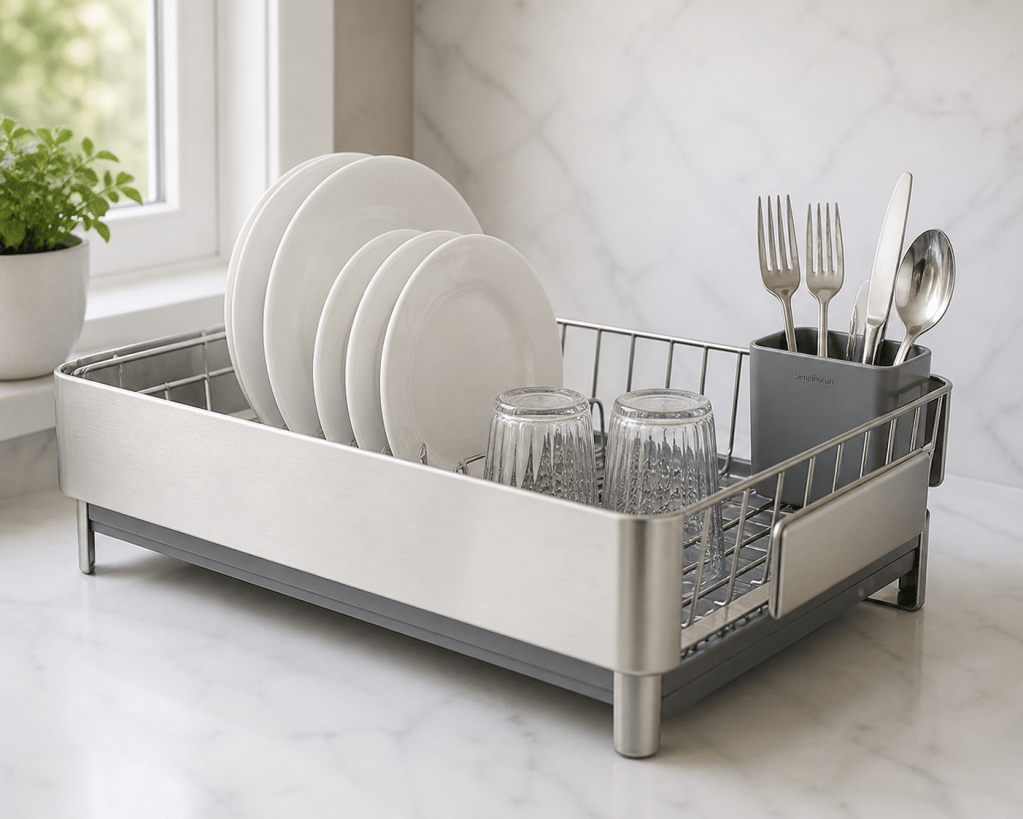

What stood out to me was how much easier it became to keep the counter clear without thinking about it. The dishes weren’t the problem anymore because they finally had a place that made sense.
The same principle shows up in less obvious ways, too.
Cords and outlets, for example, don’t take up much physical space, but they add visual noise that makes a room feel busier than it is. Even when everything else is clean, exposed cables can make a surface feel cluttered.
I didn’t think this mattered much until I fixed it. Once the cords were contained, the space felt noticeably calmer. Nothing about the layout changed, but the visual weight did.
A simple cable management solution keeps everything contained so it blends into the background instead of standing out


It’s one of those changes that doesn’t seem important until you see the difference.
When surfaces stay clear, the whole space feels more open, even if nothing else has changed. You don’t have to mentally work around clutter, and that alone makes the room feel easier to be in.
And over time, that ease is what keeps things organized without constant effort.
Making Your Space Easier to Use
Organization isn’t just about where things go, it’s about how easy they are to access. If something is inconvenient to reach, it usually ends up being left out. Over time, that’s what creates clutter.
I didn’t fully notice this until I started paying attention to the things I was leaving out on a daily basis. It wasn’t random. It was always the same items, and it always came down to the same issue — they didn’t have an easy place to go back to.
If putting something away takes more effort than leaving it out, it’s going to stay out most of the time. That’s not a habit problem, it’s a setup problem.
Once I started looking at it that way, organizing became less about finding more storage and more about making things easier to use. In smaller bedrooms, this tends to show up most clearly around the bed.
That space gets used constantly, but it’s often not set up in a way that supports that. A traditional nightstand might technically work, but in a tight layout, it can take up more room than it gives back. It can make the space feel cramped, especially if you’re already working with limited square footage.
I ran into this exact issue. The nightstand felt like it belonged there, but it didn’t actually improve how I used the space. Switching to something simpler made a bigger difference than I expected.
A bedside caddy changes the setup completely because it works with the bed instead of adding another piece of furniture next to it. It keeps everything within reach without taking up floor space, which makes the entire area feel more open.
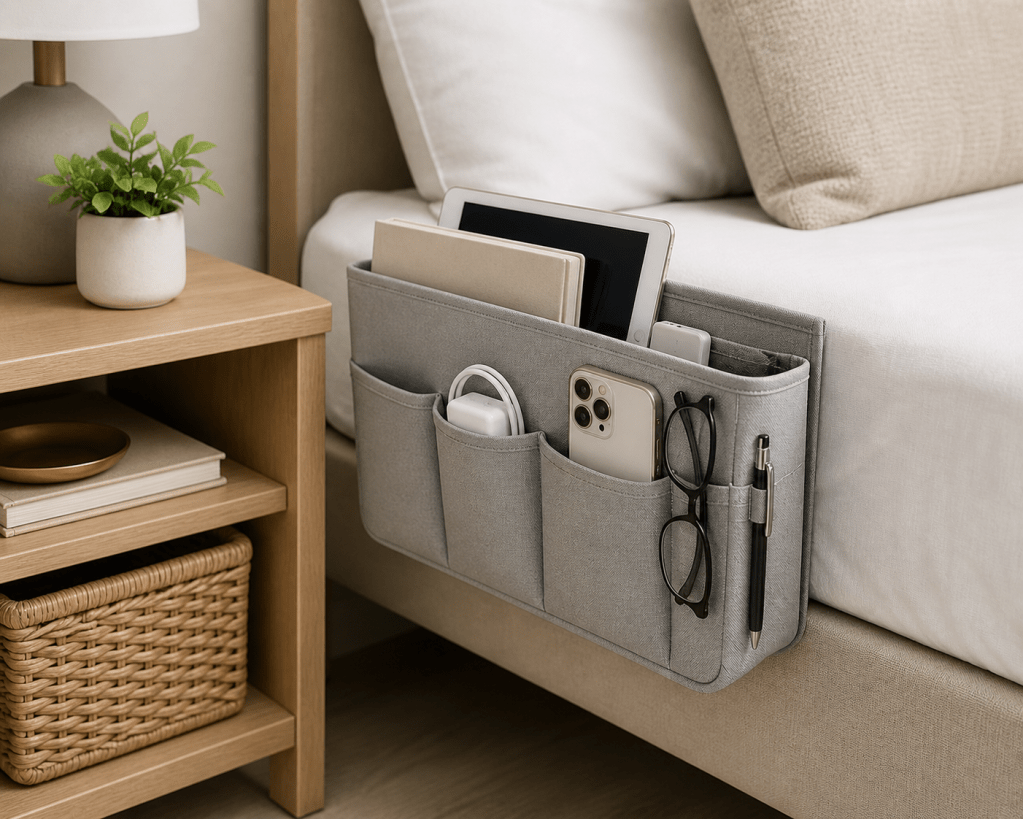
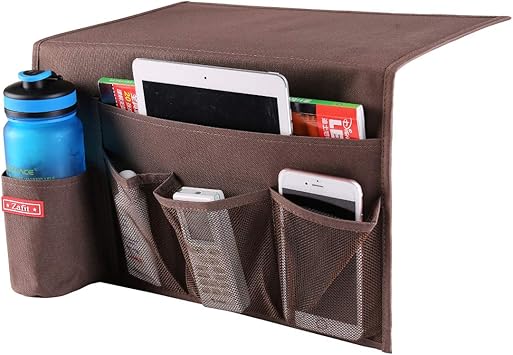
What I noticed almost immediately was that I stopped leaving things on the bed or the floor. Not because I was trying harder to stay organized, but because it was just as easy to put things away as it was to leave them out.
That’s the difference a small change like this makes. It doesn’t just organize the space, it removes the friction that was creating the clutter in the first place. And once that friction is gone, the space starts to maintain itself in a way that feels a lot more natural.
What Actually Makes a Difference Over Time
The biggest shift doesn’t come from one major change, it comes from a series of small adjustments that make your space easier to maintain.
At least, that’s how it played out for me. There wasn’t a single moment where everything suddenly felt organized. It was more gradual than that. One small fix would make something slightly easier, and then that would lead to another adjustment, and over time the space just started working better without needing constant attention.
That’s when I realized it wasn’t about doing more. It was about removing the things that made everyday use harder than it needed to be. When things are contained, surfaces stay usable. You don’t have to clear space every time you need it because it’s already available. That alone changes how the space feels day to day.
When items are easy to access, they’re easier to put away. Not because you’re trying harder, but because there’s less resistance built into the process. If something is simple to reach and simple to return, it naturally stays where it belongs more often.
And when your space supports your routines, you stop having to think about staying organized at all. That’s the part that makes the biggest difference over time.
It stops being something you have to manage and starts being something that runs in the background. You move through your space without constantly adjusting it, and that’s what makes everything feel more settled.
I also noticed that once a few areas started working better, it became easier to spot what wasn’t working elsewhere. Not in a frustrating way, just in a more obvious way. The contrast makes it clear where small changes would have the biggest impact.
That’s why it doesn’t need to happen all at once. A few small adjustments, repeated over time, end up changing the entire feel of the apartment. Eventually, the space stops feeling like something you have to work around and it starts working with you instead.
That’s when a small apartment starts to feel manageable instead of limiting.
Where to Begin
If your space feels overwhelming, it usually means one area is working against you, so start there. Not by trying to fix everything at once, but by paying attention to where things break down the most.
For me, it was never the whole apartment at once. It was always one spot that quietly created more work than everything else. A surface that constantly filled up. A corner where things got dropped without thinking. A place that required extra effort every time I tried to use it.
That’s the area to focus on first, not because it’s the worst, but because it has the biggest impact on how your space feels day to day. When something isn’t working, you notice it more often than you realize. Every time you walk past it. Every time you have to move something out of the way. Every time it slows you down just a little.
That’s what creates the feeling of overwhelm. So instead of trying to organize everything, start by removing one point of friction.
That might mean clearing a surface that constantly collects clutter. It might mean adjusting where something is stored so it’s easier to put away. It might mean getting rid of a few things that don’t fit the space as well as you thought they would.
The goal isn’t to perfect the space, it’s to make it easier to use. Once that one area starts working better, you’ll feel it immediately. Your space feels lighter, more manageable, less frustrating and that change tends to carry over.
You start noticing other small adjustments that would make things easier. Not because you’re forcing it, but because the space is no longer working against you in the same way.
That’s why starting small works better than trying to fix everything at once. You’re not just organizing one area. You’re shifting how the space functions overall, and once that shift starts, everything else becomes easier to adjust without feeling overwhelming.
Final Thoughts
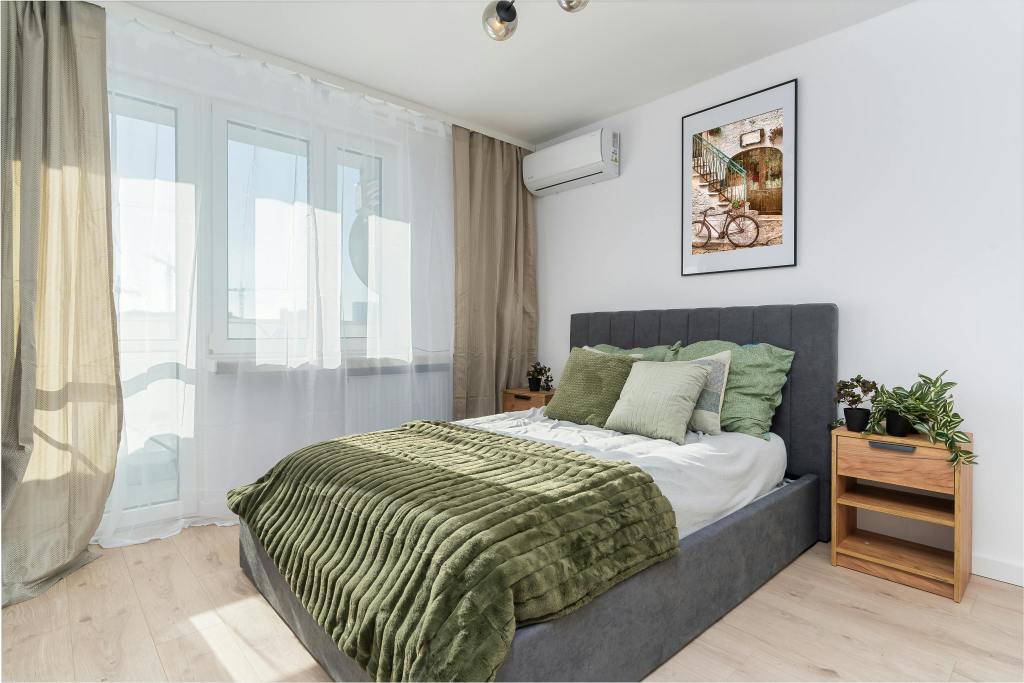
A small apartment doesn’t need more, it needs to function better.
Once your space is set up in a way that actually supports how you live, everything else starts to fall into place. It takes less effort to stay organized, less time to clean, and less energy to maintain. And when that happens, your home starts to feel calmer, more intentional, and easier to manage day to day.
What I’ve noticed is that organization isn’t really about having the “right” products. It’s about choosing things that remove friction instead of adding to it. When something works with your space instead of against it, you feel the difference almost immediately.
That’s also why this doesn’t stop with just one area.
The same ideas apply across your entire apartment. If you’re still working on creating more space, your next step should be looking at how your setup connects with your Small Apartment Decluttering Tips That Actually Work, where simplifying what you own makes organizing everything else easier. From there, your Small Apartment Closet Organization: How to Maximize Space in Even the Smallest Closets can help you take it further by making your storage actually functional instead of overwhelming.
And if you’re looking for practical upgrades that make an immediate difference, your Space Saving Products for Small Apartments That Actually Work is the natural next step. The right pieces can completely change how your space functions without adding more clutter.
Over time, all of these changes build on each other. And that’s really the goal, not to have more, but to make what you already have work better.
Leave a Reply